5 Space Mysteries So Baffling They Keep NASA Scientists Up at Night
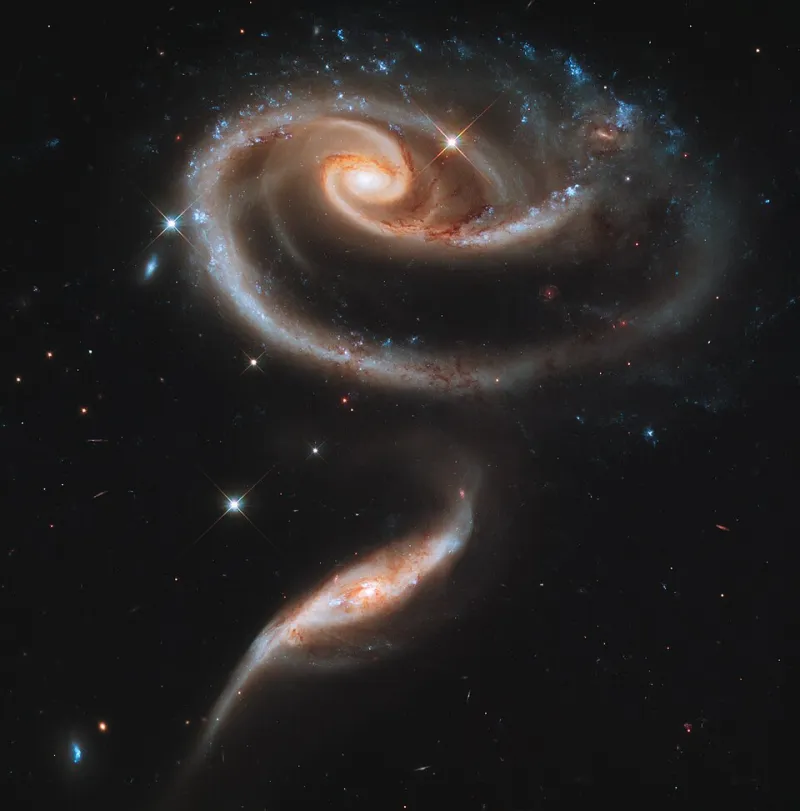
Photo: NASA, ESA, and the Hubble Heritage Team (STScI/AURA), Public domain, via Wikimedia Commons
For all the dazzling things humanity has figured out about the universe — from gravitational waves to black hole images to the age of the cosmos itself — there's a humbling truth lurking underneath all that achievement: we don't understand most of what's out there. Like, most most. The majority of the universe is made of stuff we can't see, can't touch, and can barely theorize about.
That's not a failure of science. It's actually one of the most exciting frontiers in human knowledge. Here are five of the biggest, weirdest, most stubbornly unsolved mysteries in modern astronomy — and what researchers are doing to crack them.
1. Dark Matter: The Invisible Scaffolding of Everything
What we know: Galaxies spin too fast. That's the short version of a problem that's been haunting astrophysics since the 1970s, when astronomer Vera Rubin noticed that stars at the outer edges of galaxies move at roughly the same speed as stars near the center — which should be physically impossible based on the visible mass alone. Under normal gravity, outer stars should be moving much slower, like planets in our own solar system do.
The leading explanation? There's a massive amount of invisible matter — dubbed dark matter — that doesn't interact with light but does exert gravitational pull. Current estimates suggest dark matter makes up about 27% of the universe's total mass-energy content. The ordinary stuff you, your house, and every star you've ever seen are made of? That accounts for less than 5%.
What's baffling us: Despite decades of searching, no one has directly detected a dark matter particle. Experiments buried deep underground, high-altitude balloon detectors, and powerful colliders like the Large Hadron Collider have all come up empty. We can see dark matter's gravitational fingerprints everywhere — in galaxy rotation, in gravitational lensing, in the large-scale structure of the cosmos — but the thing itself remains completely invisible.
What's being done: The James Webb Space Telescope is mapping the distribution of dark matter in galaxy clusters with unprecedented precision, helping scientists narrow down what it can't be. Meanwhile, next-generation underground detectors are hunting for hypothetical particles called WIMPs (Weakly Interacting Massive Particles) and axions. The answer, if it comes, could rewrite the entire Standard Model of particle physics.
2. Dark Energy: The Force Tearing the Universe Apart
What we know: In 1998, two independent research teams made a discovery so shocking it earned a Nobel Prize: the universe isn't just expanding — it's expanding faster and faster. Something is pushing galaxies apart at an accelerating rate, working against the gravity that should be pulling everything together. Scientists called this unknown force dark energy, and it's estimated to make up roughly 68% of the universe.
What's baffling us: Nobody knows what dark energy actually is. The most popular placeholder explanation treats it as a property of space itself — a kind of built-in repulsive pressure called the cosmological constant, which Einstein originally proposed (and then famously dismissed as his "greatest blunder"). But when physicists try to calculate what that energy density should be based on quantum mechanics, they get a number that's off from observations by a factor of 10 to the power of 120. That's not a rounding error. That's the largest discrepancy in the history of science.
What's being done: NASA's Nancy Grace Roman Space Telescope, set to launch in the late 2020s, is specifically designed to map dark energy's influence across billions of light-years. The European Space Agency's Euclid mission, already in orbit, is building the most detailed 3D map of the universe ever attempted — with dark energy squarely in its crosshairs.
3. Fast Radio Bursts: The Universe's Most Mysterious Text Messages
What we know: Every so often, radio telescopes pick up an extraordinarily powerful burst of radio waves lasting just milliseconds — releasing as much energy as the Sun puts out in three days, compressed into the blink of an eye. These Fast Radio Bursts (FRBs) come from deep space, often billions of light-years away. The first one was discovered in 2007, buried in archival data from the Parkes Observatory in Australia. Since then, hundreds have been catalogued.
What's baffling us: Most FRBs fire once and never repeat, making them nearly impossible to study in real time. A handful do repeat on irregular schedules, which rules out single catastrophic events (like colliding neutron stars) as a universal explanation. In 2020, scientists detected an FRB from within our own galaxy — traced to a type of neutron star called a magnetar — suggesting at least some FRBs have a known source. But that still doesn't explain the full picture, especially the non-repeating ones.
What's being done: The CHIME telescope in British Columbia, Canada, has become the world's premier FRB-hunting machine, detecting new bursts almost daily. Researchers are now using FRBs as cosmic probes — the way they disperse through intergalactic gas tells us about the distribution of matter between galaxies, turning a mystery into a surprisingly useful measuring tool.
4. The Great Dimming of Betelgeuse: When a Star Threw Everyone Off
What we know: Betelgeuse — the bright reddish star marking Orion's right shoulder and one of the most recognizable stars in the winter night sky — suddenly and dramatically dimmed in late 2019 and early 2020. It faded to about 40% of its normal brightness, prompting widespread speculation that it was about to explode in a supernova. Spoiler: it didn't. By April 2020, it had mostly recovered.
What's baffling us: Post-event analysis using data from the Hubble Space Telescope revealed that Betelgeuse had ejected a massive cloud of gas, which cooled into dust and temporarily blocked its light — a phenomenon called a surface mass ejection, similar to a solar flare but on a mind-boggling scale. That explained the dimming. But the event also revealed that Betelgeuse's surface temperature dropped significantly during the episode, and the star's pulsation patterns have been acting strangely ever since. Scientists aren't sure whether this was a once-in-a-generation fluke or a sign that Betelgeuse is entering a new, more volatile phase of its life.
What's being done: Betelgeuse is under near-constant observation by ground and space telescopes. JWST has been studying its dust shell in detail. Given that Betelgeuse is expected to go supernova sometime in the next 100,000 years — which is cosmically "soon" — every wobble and flicker is worth watching closely. When it does blow, it'll briefly be visible in daylight from Earth.
5. The Hubble Tension: Two Measurements, One Universe, Zero Agreement
What we know: The Hubble constant describes how fast the universe is expanding — a foundational number in all of cosmology. The problem is that two completely different methods of measuring it keep producing different answers, and neither research team can find an error in their math.
When scientists calculate the Hubble constant using the cosmic microwave background (the afterglow of the Big Bang), they get one value. When they measure it using distance ladders — chains of astronomical measurements built from Cepheid variable stars and Type Ia supernovae — they consistently get a higher number. The gap between the two is small in absolute terms but enormous in scientific significance, and it's been stubbornly refusing to close for years.
What's baffling us: This isn't a measurement error. Both methods have been checked, rechecked, and independently verified. If both are correct, it means our current model of the universe — the one that's been refined over decades into an incredibly precise and successful framework — is missing something fundamental. Some physicists think there might be unknown physics in the early universe. Others wonder if dark energy isn't as constant as we assumed.
What's being done: JWST has been re-examining the Cepheid variable star measurements at the heart of the distance ladder, looking for systematic errors that earlier telescopes might have missed. Early results have narrowed the uncertainty but haven't resolved the tension. The Hubble Tension may end up being the thread that, when pulled, unravels and rebuilds our entire cosmological model.
The universe has never promised to be easy to understand. But that's kind of the whole point of looking up — every answer we find seems to open three more questions, each stranger and more wonderful than the last. At SpaceSpin, that's exactly the kind of ride we signed up for.