Your Day Is Getting Longer — Here's the Cosmic Reason Why
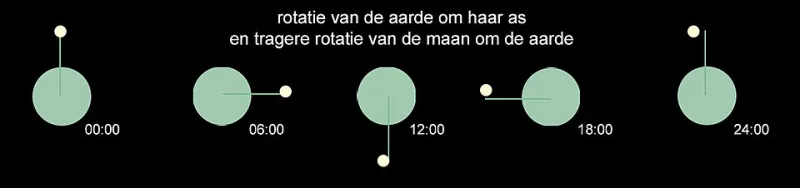
Photo: SumMus235711, CC0, via Wikimedia Commons
Imagine waking up one morning to find your phone clock is ever-so-slightly wrong — not because of a dead battery or a software glitch, but because Earth itself decided to slow down a little. Sounds like science fiction, right? Except it's completely real, it's been happening for billions of years, and scientists are working hard to keep our technology in sync with a planet that's gradually, almost imperceptibly, pumping the brakes.
Let's spin into it.
The Moon Is Basically Stealing Our Speed
Here's the setup: Earth spins on its axis once every 24 hours — or at least, that's the simplified version we all learned in school. The actual number is messier. And thanks to the Moon's gravitational grip, that number is creeping upward by roughly 1.4 milliseconds every century.
That might sound laughably small, but the physics behind it is genuinely fascinating. As Earth rotates, it drags the oceans along with it, creating tidal bulges — those familiar rises in sea level caused by the Moon's gravity. The thing is, Earth spins faster than the Moon orbits, so those tidal bulges are always slightly ahead of where the Moon is directly overhead. The Moon tugs on those bulges like a leash on a dog that's running too fast, creating a braking torque on Earth's rotation.
It's a gravitational tug-of-war that's been playing out for 4.5 billion years. Back when Earth was young and the Moon was much closer, a single day lasted only about six hours. Dinosaurs lived through 23-hour days. And in a few hundred million years, if humanity is still around to notice, days will stretch past 25 hours.
Here's the cosmic kicker: all that rotational energy Earth is losing doesn't just disappear. It gets transferred to the Moon, which is why our lunar neighbor is slowly spiraling outward — drifting about 1.5 inches farther from Earth every single year.
Why a Few Milliseconds Can Cause Real Problems
Okay, so days are getting longer. Big deal, right? You'll adjust your sleep schedule in a few million years. But the ripple effects are already showing up in technology you use every single day.
GPS satellites, for instance, rely on extraordinarily precise timekeeping. These satellites carry atomic clocks accurate to billionths of a second, and they triangulate your position by measuring how long it takes signals to travel between satellites and your device. When Earth's rotation drifts even slightly out of sync with those atomic clocks, the math gets off. The result? Small but real errors in navigation data.
The same issue crops up in global internet infrastructure, financial transaction networks, and scientific research that depends on synchronized timestamps across the globe. In a world where high-frequency stock trades happen in microseconds, a sloppy clock isn't just an inconvenience — it's a liability.
Enter the Leap Second — Time's Weirdest Band-Aid
To keep our ultra-precise atomic clocks aligned with Earth's actual rotation, scientists invented a quirky little fix: the leap second. Since 1972, the International Earth Rotation and Reference Systems Service (IERS) has periodically added a single second to Coordinated Universal Time (UTC) — the global standard that all our devices sync to.
Think of it like adjusting a clock that runs slightly fast. Every so often, you pause it for a moment to let the real world catch up.
Leap seconds have been added 27 times since the system started. But here's where it gets complicated: they don't happen on a predictable schedule. Scientists announce them only about six months in advance, after carefully monitoring Earth's rotation with a network of radio telescopes and GPS stations. That unpredictability is a nightmare for software engineers. The 2012 leap second famously crashed websites including Reddit, LinkedIn, and Qantas airline systems — all because their code didn't know how to handle a minute with 61 seconds in it.
The tech world has grown so frustrated with leap seconds that major players like Google and Meta have lobbied to abolish them entirely. In 2022, international timekeeping authorities voted to eliminate the leap second by 2035, replacing it with a more software-friendly long-term solution. The debate is ongoing, but it's a remarkable example of a cosmic phenomenon forcing a very human argument about how we measure time.
Reading Earth's Rotational History in Ancient Coral
One of the coolest tools scientists use to study Earth's ancient spin rate isn't a telescope or a particle accelerator — it's coral. Ancient coral fossils record daily and annual growth rings, and by counting those rings, paleontologists can estimate how many days were in a year hundreds of millions of years ago.
Corals from the Devonian period, roughly 400 million years back, suggest years had about 400 days. That lines up perfectly with the physics: Earth was spinning faster, days were shorter, and you needed more of them to complete an orbit around the Sun. It's a beautiful convergence of biology, geology, and orbital mechanics — all confirming that our planet really is winding down, one lazy millisecond at a time.
What This Means for You (Eventually)
In your lifetime, this slowdown is too gradual to feel or notice. You're not going to need an extra cup of coffee because your Tuesday got longer. But the downstream effects on technology are already a live issue that engineers, physicists, and policymakers are actively wrestling with.
More broadly, Earth's slowing spin is a reminder that our planet isn't a static, permanent stage for human activity. It's a dynamic system embedded in a gravitational dance with the Moon, the Sun, and the rest of the solar neighborhood — constantly changing, constantly evolving.
The next time you glance at your phone and see the time, just remember: that number is the result of a global network of atomic clocks, satellite signals, international agreements, and the gravitational influence of a rock 240,000 miles away. Your ordinary Tuesday is more cosmically complicated than it looks.
And it's going to be just a tiny bit longer tomorrow.