How the James Webb Space Telescope Is Rewriting Everything We Thought We Knew About the Cosmos
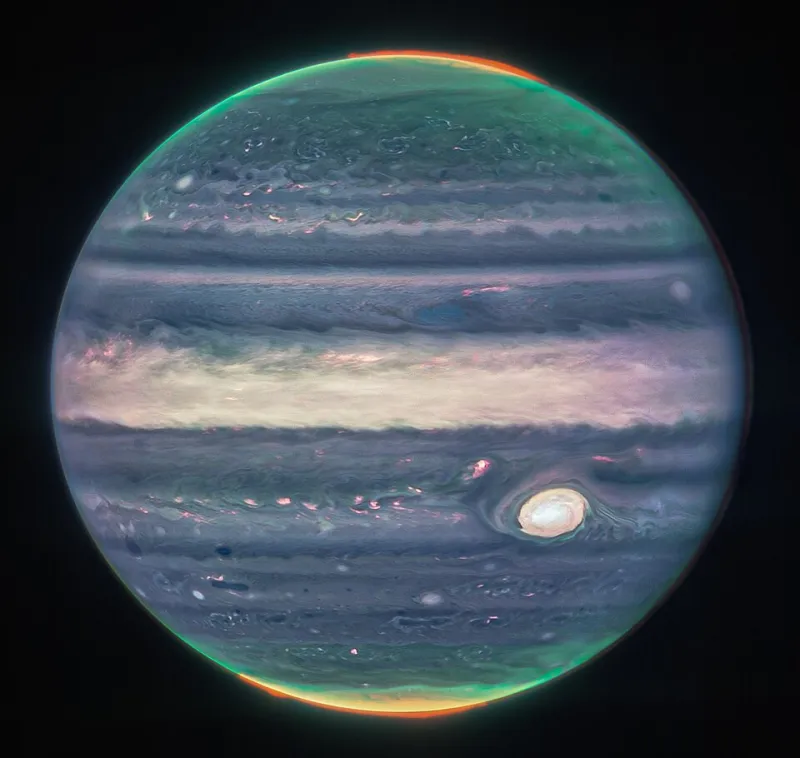
Photo: NASA's James Webb Space Telescope. Image processing by Judy Schmidt., Public domain, via Wikimedia Commons
Remember that summer day in July 2022 when President Biden stood in front of a screen and revealed the deepest infrared image of the universe ever captured? For a lot of us, it felt like a movie moment — thousands of galaxies packed into a patch of sky roughly the size of a grain of sand held at arm's length. But for astronomers, that image wasn't just beautiful. It was the opening salvo of what's turning into one of the most disruptive scientific revolutions in modern history.
The James Webb Space Telescope — JWST for short — has now been operating for a few years, and the data pouring in is doing something remarkable: it's making scientists question assumptions they've held for decades. Let's break down what's been discovered, why it matters, and what researchers are hoping to find next.
Those Early Galaxies Shouldn't Be There
Here's one of the biggest curveballs JWST has thrown at cosmology. According to the standard model of cosmic evolution — the framework astronomers have refined since the discovery of the Big Bang — large, mature galaxies take billions of years to form. You need time for gas to collapse, stars to ignite, die, and recycle their materials into new generations of stars. It's a slow, grinding process.
So when JWST started peering at the universe as it existed just a few hundred million years after the Big Bang, scientists expected to see small, chaotic, proto-galactic blobs — the cosmic equivalent of a messy teenager's bedroom. Instead, they found something that looked more like a fully furnished house. Several of these ancient galaxies appear surprisingly massive, structured, and mature — far more so than our models predicted they should be at that age.
Some researchers have called this the "universe's impossible galaxies" problem. A few scientists have even floated the idea that it could require tweaks to our foundational cosmological models, though most experts are cautious — extraordinary claims require extraordinary evidence, and the scientific community is still working through the implications. But the fact that this conversation is happening at all? That's huge.
Sniffing Alien Atmospheres Like Never Before
If the galaxy discoveries are the headline act, exoplanet science is the opening band that's somehow stealing the show. JWST was designed with the ability to analyze the light filtering through the atmospheres of planets orbiting distant stars — a technique called transmission spectroscopy. And it's delivering in a big way.
The telescope's observations of WASP-39b, a gas giant about 700 light-years from Earth, produced the most detailed chemical fingerprint of an exoplanet atmosphere ever recorded. Scientists detected carbon dioxide, sulfur dioxide, water vapor, and even signs of photochemical reactions driven by starlight — essentially, weather chemistry happening on another world.
Then there's K2-18b, a so-called "hycean" world — a planet that might be covered in a vast ocean beneath a hydrogen-rich atmosphere. JWST detected what could be a molecule called dimethyl sulfide (DMS) in its atmosphere. On Earth, DMS is produced almost exclusively by marine microorganisms. To be clear: this is not confirmation of alien life. Scientists are being appropriately careful. But it's the kind of signal that makes researchers sit up very straight and start designing follow-up observations immediately.
Nebulae in Stunning, Unprecedented Detail
Beyond the headline-grabbing discoveries, JWST has also transformed how we see the cosmic structures closer to home — relatively speaking. The telescope's infrared vision cuts through dust clouds that previously blocked our view, revealing the inner workings of stellar nurseries and the dramatic death throes of dying stars.
The Carina Nebula images released in 2022 showed towering columns of gas and dust — the so-called "cosmic cliffs" — where new stars are actively being born. What looked like a misty landscape in older Hubble images became a razor-sharp portrait of stellar formation in action. Similarly, images of the Southern Ring Nebula revealed not one but two stars at its center, reshaping our understanding of how that particular planetary nebula evolved.
Even the iconic Pillars of Creation got the JWST treatment, and the results were jaw-dropping. The new images showed hundreds of newly formed stars that were previously hidden behind thick veils of dust — a reminder that the universe has been quietly doing extraordinary things just out of our sight.
Why This Challenges the Models We've Built
Science isn't just about collecting pretty pictures — it's about testing ideas against reality. And right now, JWST is stress-testing some of our most fundamental ideas about how the universe evolved.
The Lambda Cold Dark Matter model (ΛCDM) is the reigning champion of cosmological frameworks. It describes how dark matter, dark energy, and ordinary matter interact to form the large-scale structure of the universe over time. It's been incredibly successful. But the unexpectedly massive early galaxies JWST is spotting don't fit neatly into its predictions.
Does this mean ΛCDM is wrong? Not necessarily — and most cosmologists aren't ready to throw it out. It might mean there are processes we haven't fully accounted for, like more efficient early star formation, or feedback mechanisms that work differently than simulated. Science often advances not by demolishing old models but by finding where they need patching. JWST is handing researchers a very specific set of patches to consider.
What's Next on JWST's To-Do List
The telescope is only getting started. Scientists have a packed schedule of observations lined up, and the community is buzzing with anticipation. More exoplanet atmosphere analyses are in the pipeline, with researchers hoping to build a statistical library of planetary chemistry across different star systems. The more data points they gather, the clearer the picture of what kinds of atmospheres — and potentially what kinds of life-supporting conditions — exist out there.
Astronomers are also using JWST to study the very first stars in the universe — Population III stars, as they're called — objects so ancient and so far away that no telescope has ever directly observed them. If JWST can catch even a glimpse of their light, it would fill in one of the last major blank spots in the story of cosmic history.
And then there's the ongoing hunt for more of those early "impossible" galaxies. The more examples scientists find, the better equipped they'll be to figure out whether the universe truly developed faster than expected — or whether there's something more subtle going on with how we measure cosmic distances and ages.
The Bigger Picture
What makes JWST so special isn't just its technical specs — its 21-foot gold-plated mirror, its location a million miles from Earth at the L2 Lagrange point, its ability to detect infrared light invisible to human eyes. It's what those specs enable: a fundamentally new way of asking questions about our origins.
Every time JWST turns its eye toward the sky, it's essentially doing archaeology — digging through layers of cosmic time to find clues about how everything we see around us came to be. And right now, some of those clues are pointing in directions nobody fully expected.
That's not a reason to panic or declare that science is broken. It's actually the most exciting thing that can happen in research: the universe surprising us. As any curious person knows, the best discoveries are the ones that make you say, "Wait — that can't be right. Can it?"
With JWST, that feeling is becoming a regular Tuesday.