Billions of Worlds, Zero Phone Calls: The Puzzle of Our Eerily Quiet Universe
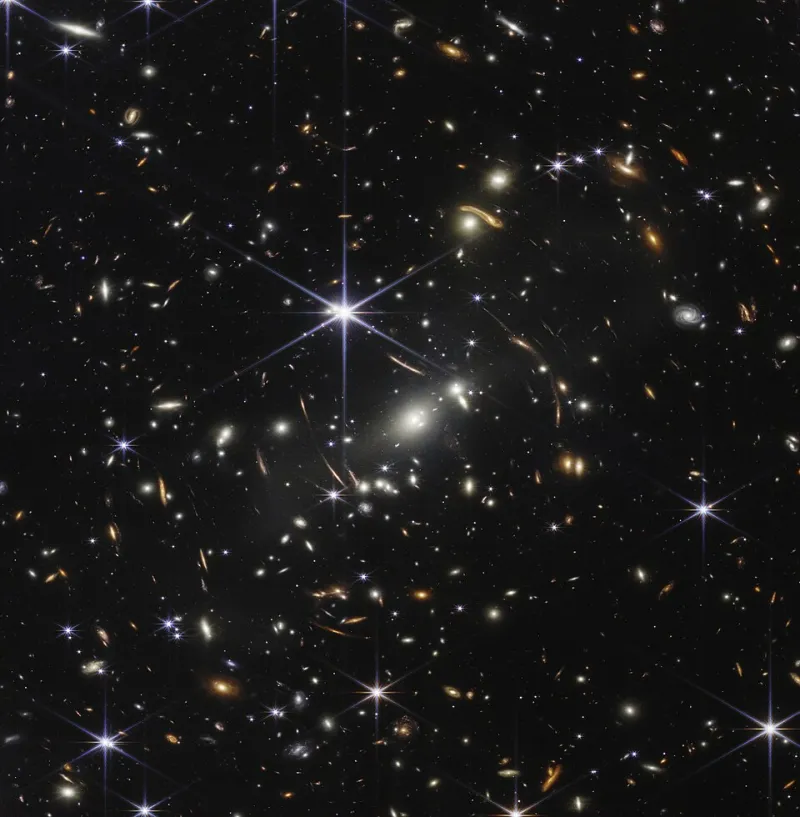
Photo: NASA, ESA, CSA, and STScI, Public domain, via Wikimedia Commons
Picture this: you throw the biggest party in history, send out invitations to every corner of the cosmos, and then spend decades sitting by the door waiting. Nobody shows. Not a knock, not a text, not even a suspicious car slowing down outside. That's essentially where humanity finds itself right now — surrounded by a universe teeming with potentially habitable real estate, and yet facing a wall of complete, baffling silence.
This is the Fermi Paradox in a nutshell, and it's one of the most deliciously maddening puzzles in all of science.
Enrico Fermi Asked the Obvious Question Nobody Could Answer
Back in 1950, physicist Enrico Fermi was having lunch with colleagues at Los Alamos when he blurted out something that has haunted scientists ever since: "Where is everybody?" The logic behind his frustration is almost annoyingly simple. The Milky Way alone contains somewhere between 100 and 400 billion stars. A significant chunk of those stars host planets. Many of those planets sit in the so-called "Goldilocks zone" — not too hot, not too cold — where liquid water can theoretically exist. Life on Earth got started relatively quickly after our planet formed, which suggests the process might not be some wildly improbable fluke.
So statistically speaking, the universe should be crawling with life. Civilizations should have had billions of years to develop, expand, and make themselves known. And yet here we are, scanning the skies with increasingly sophisticated equipment and hearing nothing but cosmic static.
The Numbers Are Almost Embarrassingly in Favor of Company
Thanks largely to NASA's Kepler Space Telescope and its successor TESS (Transiting Exoplanet Survey Satellite), astronomers have confirmed over 5,500 exoplanets to date, with thousands more candidates waiting in the queue. Early estimates suggest there could be as many as 40 billion Earth-sized planets orbiting in habitable zones across the Milky Way alone.
Let that sink in for a second. Forty. Billion.
Even if only a tiny fraction of those worlds ever developed microbial life, and an even tinier fraction evolved into something complex, the sheer scale of the numbers suggests we should have bumped into someone by now. The universe has been running its experiment for nearly 14 billion years. That's an almost incomprehensible head start over our own civilization, which has been broadcasting radio signals for barely a century.
So what gives?
The Theories Range From Sobering to Downright Terrifying
Scientists and philosophers have cooked up a fascinating — and occasionally nightmare-inducing — menu of explanations.
One popular idea is the Great Filter: the notion that somewhere along the path from simple chemistry to spacefaring civilization, there's a nearly insurmountable hurdle that almost everything fails to clear. The optimistic version says the filter is behind us — maybe the leap from single-celled life to complex multicellular organisms is extraordinarily rare, and we somehow got lucky. The terrifying version? The filter might still be ahead of us.
Then there's the Rare Earth Hypothesis, which argues that Earth's specific combination of factors — a large stabilizing moon, a protective Jupiter acting as a cosmic shield, plate tectonics, a magnetic field — is so unusual that complex life is genuinely exceptional in the universe.
Others suggest that advanced civilizations might deliberately go quiet, either to avoid detection from potentially hostile neighbors (the "Dark Forest" theory, popularized in Chinese science fiction) or because they've moved beyond radio waves into communication methods we haven't invented yet. Trying to detect their signals, in this scenario, would be like a medieval peasant trying to pick up a WiFi signal.
And some researchers simply argue we haven't looked hard enough, long enough, or in the right places. Our SETI efforts, impressive as they are, have only meaningfully surveyed a small slice of the galaxy.
New Telescopes Are About to Change the Game Completely
Here's where things get genuinely exciting. For most of human history, the question of alien life was firmly in the territory of philosophy and late-night dorm room debates. That's rapidly changing.
The James Webb Space Telescope has already demonstrated a jaw-dropping ability to analyze the atmospheres of distant exoplanets by studying how starlight filters through them during a transit. Scientists are hunting for what are called biosignatures — chemical fingerprints that would be hard to explain without biology. Oxygen, methane, ozone, and a molecule called dimethyl sulfide (which on Earth is produced almost exclusively by marine microbes) are all on the checklist.
But Webb is just the opening act. NASA's Nancy Grace Roman Space Telescope, set to launch in the next few years, will survey the sky with a field of view roughly 100 times larger than Hubble's. Meanwhile, ground-based giants like the Extremely Large Telescope currently under construction in Chile's Atacama Desert will sport a primary mirror stretching 128 feet across — large enough to directly image Earth-like planets around nearby stars and study their atmospheres in unprecedented detail.
The European Space Agency's LIFE mission concept, still in development, proposes a space-based interferometer specifically designed to detect infrared biosignatures from rocky planets. If it gets the green light, it could survey dozens of nearby star systems for signs of life within a few decades.
We're not just listening anymore. We're learning to actually look.
What Would Finding Something Actually Mean?
Here's a thought experiment worth sitting with: what happens to the Fermi Paradox if Webb or one of its successors detects a compelling biosignature in the atmosphere of a planet 40 light-years away?
In one sense, it would be the most profound discovery in human history — confirmation that life is not a cosmic accident unique to Earth. But it would also sharpen the paradox rather than dissolve it. Microbial life existing somewhere doesn't explain why no technological civilization has ever made contact. If anything, it makes the silence louder.
Detecting life — even primitive life — would reframe every question we have about the universe's apparent emptiness. It would tell us the Great Filter probably isn't in life's origins. Which means, uncomfortably, it might lie somewhere further down the road.
The Silence Might Be the Most Important Signal of All
There's a strange kind of meaning in the quiet. Every year that passes without confirmed contact is itself a data point — a clue about the distribution, longevity, and behavior of intelligent life in the cosmos. Scientists are increasingly treating the absence of a signal as scientifically valuable information, not just a frustrating null result.
And honestly? We're still early in the search. Humanity has been actively scanning the skies for extraterrestrial signals for less than a human lifetime. The universe is 13.8 billion years old. In cosmic terms, we've barely cracked the door open.
The next decade of astronomy promises to be unlike anything that came before. New eyes are opening on the sky — sharper, more sensitive, and purpose-built to sniff out the chemical whispers of life across interstellar distances. Whether those instruments finally break the silence, or confirm it in ways that demand a whole new set of questions, one thing is certain: the universe is about to get a lot harder to ignore.
Fermi asked where everybody was. We're finally close to having the tools to find out.