You Are Stardust: The Wild Journey of Atoms From Dying Stars to Your Body
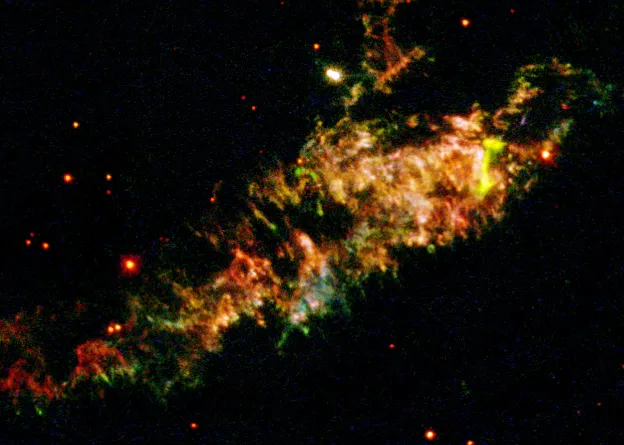
Photo: NASA/ESA and the Hubble Heritage Team (STScI/AURA), Public domain, via Wikimedia Commons
We Are All Made of Star Stuff — But What Does That Actually Mean?
You've probably heard the phrase before, maybe on a poster in a science classroom or in a Carl Sagan documentary late at night. "We are made of star stuff." It sounds poetic, almost too poetic to be real. But here's the thing — it's not just a feel-good sentiment. It's cold, hard astrophysics. Every carbon atom in your DNA, every oxygen molecule you're breathing right now, every bit of iron keeping your blood red: all of it was forged inside a star that exploded before our solar system even existed.
That's not a metaphor. That's your actual origin story.
So let's break down how it happens — because the process is even wilder than the bumper sticker version suggests.
Stars Are the Universe's Original Factories
When the universe was born in the Big Bang about 13.8 billion years ago, it was almost embarrassingly simple. Mostly hydrogen. A little helium. Trace amounts of lithium. That's it. The periodic table we know today — with its 118 elements — didn't exist yet. The cosmos had to build it from scratch.
Enter stars.
At the core of every star, gravity crushes hydrogen atoms together with such force that they fuse into helium. This process, called nuclear fusion, releases an enormous amount of energy — which is why stars shine. But fusion doesn't stop at helium. As a star ages and its hydrogen supply runs low, it starts fusing helium into heavier elements: carbon, nitrogen, oxygen. For massive stars — we're talking stars at least eight times the size of our Sun — this process keeps going. Carbon fuses into neon. Neon into magnesium. Magnesium into silicon. And eventually, silicon fuses into iron.
This entire sequence is called stellar nucleosynthesis, and it's basically the universe's way of running a chemistry lab inside a ball of plasma.
Why Iron Is a Dead End
Here's where things get dramatic. Iron is special — and not in a good way, at least from a star's perspective. Unlike every other element a star produces, fusing iron actually consumes energy rather than releasing it. For a star that has spent its entire life generating energy through fusion, iron is essentially a poison.
Once an iron core builds up at the center of a massive star, fusion effectively stops. The core can no longer support itself against the crushing weight of the layers above it. In less than a second — literally — the core collapses. And what happens next is one of the most violent events in the known universe.
The Supernova: Nature's Most Spectacular Explosion
When that iron core collapses, it triggers a supernova — a cataclysmic explosion that can briefly outshine an entire galaxy of hundreds of billions of stars. The outer layers of the star get blasted outward at speeds of up to 25,000 miles per second. All those elements the star spent millions or billions of years carefully building up? They get flung into the surrounding space in a spectacular, cosmic shockwave.
But it gets better. The supernova explosion itself is so energetically intense that it creates elements heavier than iron — things like gold, silver, uranium, and platinum — through a rapid process called the r-process (short for rapid neutron capture). So if you're wearing a gold ring, congratulations: that gold was forged in a stellar explosion. Probably multiple stellar explosions, actually.
The debris from supernovae doesn't just vanish. It drifts through interstellar space for millions of years, slowly mixing with surrounding gas and dust clouds. Eventually, gravity pulls those enriched clouds together again. New stars form. New planets form around those stars. And on at least one of those planets — a pale blue dot about 93 million miles from a medium-sized star in a quiet corner of the Milky Way — the chemistry got complicated enough to produce life.
Tracing the Atoms in Your Body
Let's make this personal for a second. The average adult human body contains roughly 7 billion billion billion atoms. That's a 7 followed by 27 zeros. About 65% of those atoms are oxygen, 18% are carbon, and the rest are a mix of hydrogen, nitrogen, calcium, phosphorus, and dozens of other elements.
The hydrogen in your body is actually old enough to have come from the Big Bang itself — hydrogen is that original element, no star required. But your carbon? That was built inside a star. The oxygen you breathe? Star-forged. The calcium in your bones, the iron in your hemoglobin, the nitrogen in your proteins — all of it passed through the interior of at least one star, and likely several, before finding its way to Earth.
Think about that the next time you're sitting in traffic on I-95 or waiting for your coffee to brew. The atoms in your hands have been part of nebulae, planetary systems, and stellar furnaces. They've been traveling through the cosmos for billions of years just to end up... here.
Why This Matters Beyond the Cool Factor
Okay, so it's a great conversation starter at parties. But understanding stellar nucleosynthesis isn't just trivia — it's foundational to understanding where we come from and, honestly, where we might find life elsewhere.
When astronomers study the chemical composition of stars in distant galaxies, they're essentially reading a history of how those galaxies evolved. Stars that formed early in the universe were made almost entirely of hydrogen and helium. Later generations of stars — like our Sun — are enriched with heavier elements, the leftovers from previous stellar generations. The more "metal-rich" a star is (astronomers use the term "metals" loosely to mean anything heavier than helium), the more likely it is to host rocky planets like Earth, and potentially life.
Missions like NASA's James Webb Space Telescope are helping scientists trace these chemical fingerprints across cosmic time, essentially mapping the universe's element-building history. Every data point adds to our understanding of how the cosmos went from a simple soup of hydrogen to a place complex enough to produce DNA.
The Cycle Continues
Here's the most mind-bending part of all: this process isn't finished. Stars are still exploding. New elements are still being scattered across galaxies. New solar systems are forming right now inside nebulae like the famous Pillars of Creation. The cosmic recycling plant never shuts down.
And someday — in about 5 billion years — our own Sun will exhaust its fuel, swell into a red giant, and shed its outer layers into space. Those layers will contain carbon and oxygen that the Sun spent its lifetime producing. That material will drift into the galaxy and eventually become part of new stars, new planets, maybe new life.
We didn't just come from the stars. We're part of an ongoing cycle that the universe has been running since the very beginning. And that, more than anything, is what makes looking up at the night sky feel a little less like staring into the void — and a lot more like looking in a mirror.