Dead Stars That Won't Sit Still: The Astonishing Science of Neutron Stars
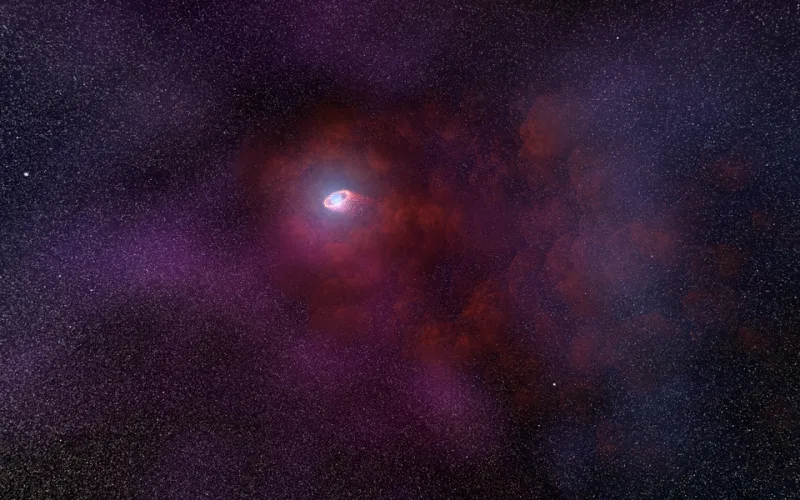
Photo: NASA, ESA, and N. Tr’Ehnl (Pennsylvania State University), Public domain, via Wikimedia Commons
Imagine something roughly the size of Chicago — maybe 12 to 15 miles across — but so mind-blowingly dense that it outweighs our entire Sun. Now picture that object spinning hundreds of times every single second, sweeping beams of radio waves across the cosmos like the world's most dramatic lighthouse. Oh, and it's doing all of this in the cold, dark silence of deep space, completely alone.
That's a neutron star. And honestly, it might be the most extreme thing in the universe that you can still technically call "matter."
What Even Is a Neutron Star?
To understand what a neutron star is, you have to go back to the death of a giant. When a star roughly 8 to 20 times more massive than our Sun runs out of fuel, it collapses under its own gravity in a spectacular supernova explosion. The outer layers get blasted into space, but the core — if it's in the right mass range — doesn't become a black hole. Instead, it gets squeezed so hard that electrons and protons are literally crushed together into neutrons.
What's left is a neutron star: a sphere of almost pure neutron matter, held up not by heat or nuclear fusion, but by a quantum mechanical principle called neutron degeneracy pressure. In plain English, neutrons resist being squeezed any closer together, and that resistance is the only thing standing between a neutron star and a complete gravitational collapse into a black hole.
The numbers involved are almost offensive to human intuition. A single teaspoon of neutron star material would weigh somewhere in the neighborhood of 10 million tons — roughly equivalent to the mass of Mount Everest packed into something smaller than a sugar cube. Gravity at the surface is about 200 billion times stronger than what we feel on Earth. If you somehow dropped a marshmallow from a foot above the surface, it would hit with the energy of a nuclear bomb.
The Pulsars: Cosmic Metronomes
One of the most fascinating flavors of neutron star is the pulsar. When a neutron star rotates — and they all rotate, some of them absurdly fast — it can emit beams of electromagnetic radiation from its magnetic poles. If those beams happen to sweep across Earth as the star spins, we detect them as incredibly regular pulses of radio waves.
And we mean regular. Some pulsars are so precise in their timing that they rival atomic clocks. Scientists actually use certain millisecond pulsars — the fastest-spinning ones, completing hundreds of rotations per second — as tools to detect long-wavelength gravitational waves passing through our galaxy. Arrays of these pulsars spread across the sky act like a giant cosmic detector, measuring tiny variations in pulse timing caused by ripples in spacetime itself.
The fastest known pulsar, PSR J1748-2446ad, spins at about 716 times per second. That's a surface moving at roughly 24 percent the speed of light. Let that sink in for a moment.
A Laboratory You Could Never Build on Earth
Here's the thing that gets physicists genuinely excited: we have absolutely no way to recreate the conditions inside a neutron star in any lab on Earth. The pressures and densities involved are so extreme that our best theories of matter — the ones that work beautifully everywhere else — start to break down or make contradictory predictions.
What's actually happening deep inside a neutron star? That's an open question. Some models suggest the core might contain exotic states of matter like strange quark matter, where quarks roam freely rather than being bound inside neutrons and protons. Others propose something called a superfluid — a frictionless quantum liquid of neutrons — might exist in the inner layers. There are even speculative models involving particles called hyperons, which contain strange quarks, or condensates of pions and kaons.
The honest answer is: we don't fully know. And that uncertainty is exactly what makes neutron stars so scientifically valuable. Every observation we make of them is a clue about the behavior of matter at densities we can't probe any other way.
Gravitational Waves and Cosmic Collisions
In 2017, the scientific world got genuinely giddy when LIGO and Virgo detected gravitational waves from two neutron stars spiraling into each other and merging — an event dubbed GW170817. It was the first time gravitational waves and light were detected from the same cosmic event simultaneously, kicking off a new era called multi-messenger astronomy.
The merger produced a kilonova: a dazzling explosion that forged heavy elements like gold, platinum, and uranium in real time. That jewelry on your finger? There's a decent chance the gold in it was forged in a neutron star collision billions of years ago. The universe has a flair for the dramatic.
That single event told us more about neutron star interiors, the speed of gravity, and the origin of heavy elements than decades of previous research. And scientists are hungry for more. As gravitational wave detectors improve, we expect to catch dozens or even hundreds of these mergers, each one adding another data point to our understanding of ultra-dense matter.
Magnetars: When Neutron Stars Go Even Further
If regular neutron stars aren't extreme enough for you, allow us to introduce magnetars — neutron stars with magnetic fields so powerful they make ordinary pulsars look tame. A magnetar's magnetic field can be a thousand times stronger than a typical neutron star's, and roughly a quadrillion times stronger than Earth's.
These objects occasionally release bursts of X-rays and gamma rays in what are called starquakes — sudden shifts in the star's rigid crust. In December 2004, a magnetar about 50,000 light-years away released so much energy in a fraction of a second that it partially ionized Earth's upper atmosphere. From 50,000 light-years away. If that magnetar had been as close as some of our neighboring stars, the consequences would have been catastrophic.
Why We Keep Watching
Neutron stars are, in a very real sense, the universe showing off. They sit right at the edge of what matter can do before it crosses into the territory of black holes — and studying that edge is one of the most productive things modern astrophysics can do.
Every time a new pulsar is discovered, every gravitational wave detection, every magnetar flare picked up by space telescopes like NASA's NICER (which is literally mounted on the International Space Station specifically to study neutron stars) — each of these is another spin of the dial, bringing the physics of extreme matter a little more into focus.
For curious minds, that's the real magic here. These aren't just exotic curiosities sitting at the edge of human knowledge. They're nature's own experiments, running continuously in the dark between the stars, waiting for us to read the results. And we're only just getting started.