Star Trails Around a Monster: The Wild Orbital Paths Near Supermassive Black Holes
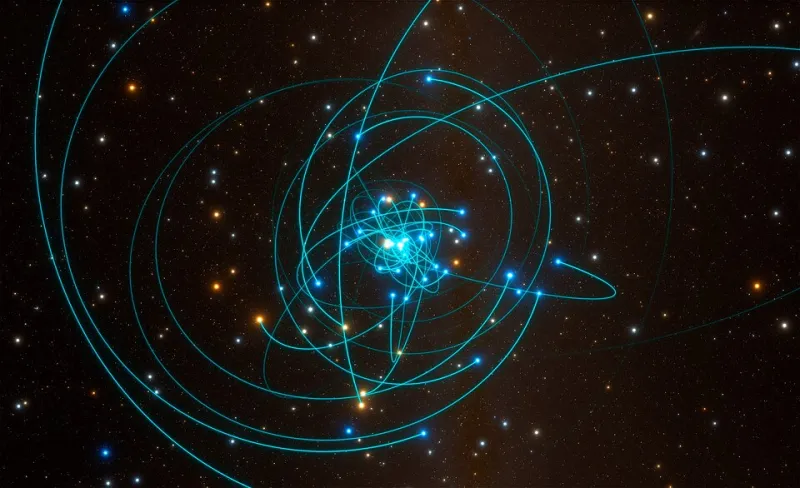
Photo: ESO/L. Calçada/spaceengine.org, CC BY 4.0, via Wikimedia Commons
Imagine strapping yourself to a roller coaster that swings you within a few light-hours of a four-million-solar-mass black hole, whips you around at thousands of miles per second, and then flings you back out into the cold dark of space — only to do it all over again, forever. That's roughly the life of a star near the center of the Milky Way. And honestly? It's one of the most spectacular things happening in our entire galaxy right now.
The orbital mechanics going on around supermassive black holes aren't just visually dramatic. They're also one of the most powerful tools astronomers have for proving these invisible giants actually exist — and for measuring exactly how massive they are. Let's spin through the details.
The Galactic Center Is Not a Quiet Neighborhood
The core of the Milky Way sits about 26,000 light-years from Earth, tucked behind thick clouds of gas and dust that make it completely invisible to ordinary telescopes. For a long time, astronomers knew something big was going on in there — powerful radio emissions, unusual X-ray flares, and strange infrared signals all hinted at a chaotic, energetic environment. But pinning down what was actually causing all that commotion took decades of patient observation.
The breakthrough came when researchers started using infrared telescopes capable of cutting through all that cosmic fog. Two independent teams — one led by Andrea Ghez at UCLA, the other by Reinhard Genzel at the Max Planck Institute in Germany — spent the better part of 30 years tracking individual stars near the galactic center. What they found was extraordinary enough to earn both scientists a share of the 2020 Nobel Prize in Physics.
At the very heart of the galaxy, a cluster of stars called the S-stars (or sometimes the S-cluster) traces out tight, elongated orbits around a single point in space. That point has no visible light source. Nothing glows there. But it bends the paths of nearby stars like nothing else in the known universe.
Ellipses, Not Circles: Why These Orbits Look So Strange
Here's something that trips people up at first: orbits in space are almost never perfect circles. Thanks to the rules Johannes Kepler worked out back in the 1600s, objects in gravitational systems tend to trace ellipses — stretched-out ovals where the central mass sits at one focus, not the center.
Near a supermassive black hole, those ellipses get extreme. The most famous example is a star called S2 (also labeled S-O2 by some teams). S2 orbits the black hole at the Milky Way's center — a region astronomers call Sagittarius A*, or Sgr A* for short — on a path so elongated that at its closest approach, it screams past at roughly 3% the speed of light. That's about 5,000 miles per second. Its full orbital period is only about 16 years, which sounds like a long time until you realize it's traveling an enormous distance to complete that loop.
Other stars in the S-cluster have even tighter, faster orbits. S62, for instance, completes a full trip around Sgr A* in under 10 years and reaches speeds approaching 10% of the speed of light at closest approach. These aren't gentle, lazy circles — they're gravitational slingshots, repeating endlessly.
How Astronomers Actually Track This
You might wonder how scientists watch individual stars that are 26,000 light-years away, hidden behind clouds of interstellar dust, moving fast enough to visibly shift position over just a few years. The answer involves some genuinely impressive technology and a whole lot of patience.
Infrared adaptive optics systems — essentially high-tech tools that correct for the blurring effect of Earth's atmosphere in real time — allow ground-based telescopes to resolve individual stars in the densely packed galactic center. Observatories like the Keck telescopes in Hawaii and the Very Large Telescope in Chile have been snapping infrared images of the S-cluster year after year, building up a time-lapse record of stellar motion that spans multiple decades.
By measuring tiny shifts in each star's position over time and combining that with Doppler measurements of how fast each star is moving toward or away from us, astronomers can reconstruct complete three-dimensional orbital paths. It's the same basic principle as tracking a ball thrown across a room, just applied across unimaginable distances — and the math is considerably more complicated.
Once you have those orbital paths, the mass of the central object pops right out of the equations. For Sgr A*, the numbers consistently point to roughly 4 million times the mass of our Sun, all crammed into a region smaller than our solar system. There's simply no known type of object other than a black hole that could pack that much mass into that small a space.
General Relativity Gets Its Close-Up
Tracking stars near Sgr A* isn't just useful for confirming the black hole's existence — it's also a remarkable laboratory for testing Einstein's general theory of relativity under extreme conditions.
In 2018, as S2 made its closest approach to Sgr A*, astronomers detected a phenomenon called gravitational redshift. The star's light was stretched to longer, redder wavelengths as it climbed out of the black hole's intense gravitational well, exactly as Einstein's equations predicted. A year later, researchers announced they'd detected another relativistic effect in S2's orbit: a slow rotation of the orbit's orientation over time, called Schwarzschild precession. Think of it like a spirograph pattern — the ellipse itself gradually pivots, tracing out a rosette shape over many orbital cycles. Newton's gravity alone can't explain it. General relativity can.
These aren't just academic curiosities. Every time a real-world observation matches a prediction from general relativity in an extreme environment like this, it reinforces our confidence in the theory and nudges physicists a little closer to understanding how gravity works at its most dramatic.
What This Means for Black Holes Everywhere
Sgr A* is the most closely studied supermassive black hole in the universe simply because it's the closest one to us. But astronomers believe virtually every large galaxy harbors one of these giants at its core. The orbital dynamics we've mapped in our own galactic backyard give scientists a template for interpreting observations of more distant galactic centers, where individual stars can't be resolved but broader patterns of stellar motion still carry the gravitational fingerprints of the black holes driving them.
In a very real sense, the stars of the S-cluster are cosmic messengers. Their looping, high-speed paths around an invisible point in space tell us something profound: that the universe's most extreme objects — things so dense that not even light escapes them — can be studied, measured, and understood, even if they can never be directly seen.
The galaxy's center is spinning its own story. And thanks to a few patient decades of stargazing, we're finally starting to read it.