Earth's Slow-Motion Wobble Has Been Quietly Rewriting the Night Sky for Thousands of Years
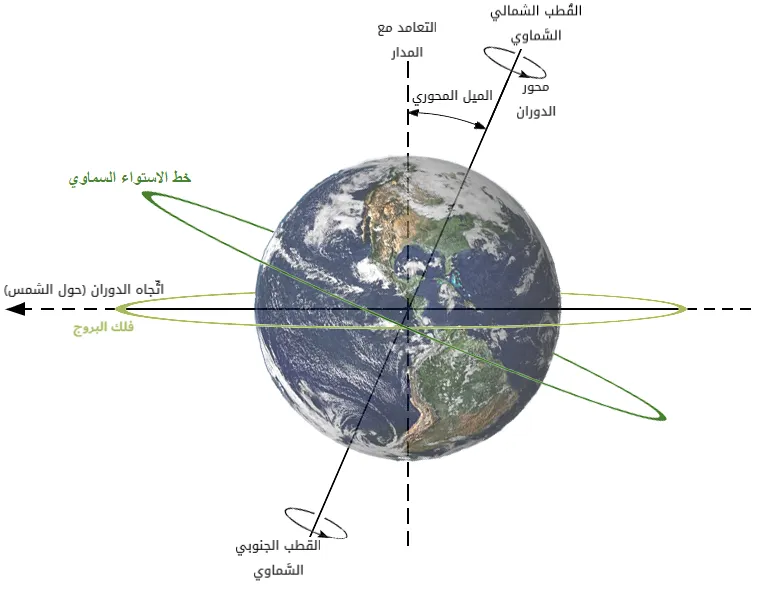
Photo: Original: Dna-webmaster Derivative: Originally Abbad on ar.wiki. Remade by باسم., Public domain, via Wikimedia Commons
Picture a spinning top on a table. As it slows down, its axis doesn't just stay perfectly upright — it starts to drift in a slow, wide circle before eventually toppling over. Earth does something eerily similar, except on a timescale so vast that no single human life, or even civilization, gets to witness the full show. Over roughly 26,000 years, our planet's rotational axis traces out a complete circle against the backdrop of the stars. Scientists call this axial precession, and its fingerprints are all over human history.
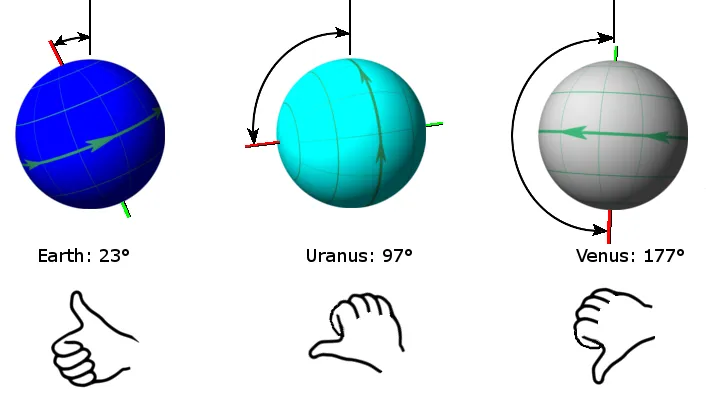
Most of us learn that Earth spins on a tilted axis — about 23.5 degrees off vertical — and that this tilt is responsible for our seasons. But fewer people know that the direction that axis points is constantly, slowly changing. Right now, Earth's north pole aims pretty close to Polaris, the North Star. But that hasn't always been the case, and it won't stay that way forever. Axial precession is the reason why, and understanding it opens up a surprisingly deep window into both our ancient past and our distant future.
Why Earth Wobbles in the First Place
The culprit here is gravity — specifically, the combined gravitational tugging of the Moon and the Sun on Earth's equatorial bulge. Because Earth isn't a perfect sphere (it bulges slightly at the equator), these gravitational forces have something to grip. They pull on that bulge in a way that doesn't simply stop the tilt, but instead causes the whole axis to precess — to sweep slowly around in a circle, like that wobbling top.
The full cycle takes approximately 25,772 years to complete. In cosmic terms, that's barely a blink. On human timescales, though, it's enormous — long enough to have meaningfully changed the sky that every major ancient civilization looked up at.
It's worth noting that precession is distinct from Earth's tilt itself, which stays relatively stable (though it does vary slightly over longer cycles). Precession is purely about the direction the axis points, not the degree of the tilt.
The North Star Isn't Forever
Here's something that might genuinely mess with your sense of permanence: Polaris, the star we've relied on for navigation for centuries, is only a temporary north star. Around 3000 BCE — right when the ancient Egyptians were building the first pyramids — the north celestial pole was pointing toward a star called Thuban, in the constellation Draco. Some researchers believe that the descending passage of the Great Pyramid of Giza was designed to align with Thuban, allowing light to shine directly down it during certain nights. If that's true, it's a breathtaking example of ancient astronomers working with the sky as it actually existed in their time, not ours.
Fast forward to roughly 14,000 CE, and Earth's north pole will point toward Vega, one of the brightest stars in the sky. Future navigators won't look for Polaris at all — they'll look for Vega. And then, about 26,000 years from now, the cycle completes and Polaris reclaims its throne.
How Precession Scrambled the Zodiac
If you've ever read your horoscope, you've encountered a relic of precession without knowing it. The Western zodiac was codified by ancient Greek and Babylonian astronomers based on which constellation the Sun appeared to pass through during each month of the year. The problem? Precession has been slowly shifting those alignments ever since.
Today, when astrologers say the Sun is in Aries during late March, the Sun is actually sitting in front of the constellation Pisces. The entire zodiac has drifted by about one full sign over the past two millennia. This is sometimes called the "precession of the equinoxes," because it also shifts the dates when the Sun crosses the equinoxes — the moments when day and night are equal length.
The ancient Greek astronomer Hipparchus is generally credited with discovering precession around 127 BCE, when he compared his star observations to older Babylonian records and noticed that the positions had shifted. It was one of the most important astronomical discoveries of the ancient world.
Stonehenge, Calendars, and the Confusion of the Ancients
Precession didn't just affect the zodiac — it created real headaches for any civilization trying to build a lasting astronomical calendar. Stonehenge, for example, is famously aligned with the summer solstice sunrise. But because of precession, the precise alignment has shifted since the monument was constructed around 3000–2000 BCE. The structure still roughly works for solstice observations, but the details have drifted.
Many ancient cultures built monuments with celestial alignments baked in — temples in Egypt, pyramids in Mesoamerica, stone circles across Europe. As precession slowly moved the stars, these alignments gradually fell out of sync with their original intent. Some cultures updated their observations; others may not have fully understood why their inherited astronomical knowledge seemed slightly "off."
For archaeoastronomers — researchers who study the astronomical knowledge of ancient peoples — precession is both a tool and a puzzle. By calculating where the stars would have been at a given location and date in the past, they can sometimes determine when a particular monument was built or what its builders were watching.
What Precession Means for Our Seasons (Sort Of)
Here's a subtler effect that often gets overlooked. Right now, Earth happens to be closest to the Sun (a point called perihelion) in early January — right in the middle of Northern Hemisphere winter. That actually moderates our winters slightly, since we're getting a tiny bit more solar energy than we would otherwise. Our summers, meanwhile, occur when we're slightly farther from the Sun, which moderates them too. The result: Northern Hemisphere seasons are relatively mild compared to what they could be.
In about 13,000 years, precession will have flipped this relationship. Perihelion will occur in July, meaning Northern Hemisphere summers will be hotter and winters colder. This shift is one of several overlapping astronomical cycles — known collectively as Milankovitch cycles — that scientists believe have driven Earth's ice ages over millions of years. Precession alone doesn't cause an ice age, but combined with other orbital variations, it's part of the mechanism that tips Earth's climate from one long-term state to another.
The Wobble We Can't Stop — And Shouldn't Want To
There's something almost meditative about axial precession once you sit with it. Every generation of humans has looked up at a sky that is, in some small but measurable way, different from what their ancestors saw and what their descendants will see. The constellations drift. The north star changes. The seasons shift, imperceptibly but relentlessly.
And yet, the mechanism driving all of this is the same gravitational dance that keeps our Moon in orbit and our tides rolling in and out. It's the universe doing what it does — pulling, tugging, nudging everything into motion.
For curious sky-watchers in the US and around the world, this is one of those facts about Earth that reframes everything. The night sky isn't a fixed backdrop. It's a slowly spinning stage, and humanity has only been watching for a tiny fraction of the performance. The wobble that shaped civilizations is still going, quietly, right now — carrying all of us along with it whether we notice or not.