Gravity's Dance Floor: The Spectacular Science of How Galaxies Move, Merge, and Transform
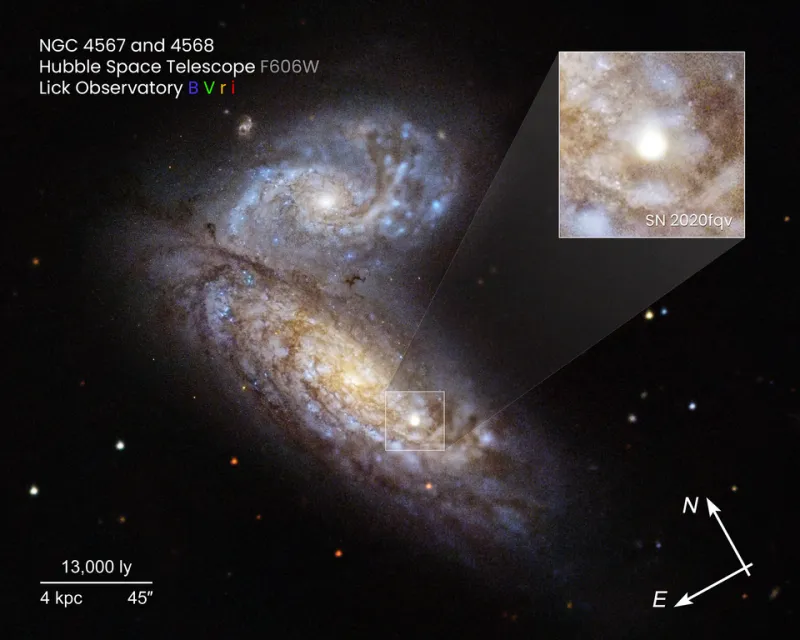
Photo: AUTHOR: Ryan Foley (UC Santa Cruz), Public domain, via Wikimedia Commons
Picture the most jaw-dropping light show you've ever seen — fireworks over the National Mall on the Fourth of July, maybe, or a lightning storm rolling across the Great Plains. Now imagine scaling that up by roughly a trillion times. That's still not quite the spectacle of two galaxies colliding. These are events involving hundreds of billions of stars, vast clouds of gas, and invisible halos of mysterious dark matter, all locked in a gravitational embrace that plays out across hundreds of millions of years.
Welcome to the universe's grandest stage. Let's talk about what's actually going on.
Why Galaxies Spin in the First Place
Before we get to the collisions, it helps to understand why galaxies rotate at all. It comes down to a concept called angular momentum — the same physics that keeps a figure skater spinning when she pulls her arms in tight. When the universe was young and matter began clumping together under gravity, those early clouds of gas weren't perfectly still. They had slight, random motions. As gravity pulled material inward, those motions became organized into rotation, the same way water spiraling down a drain picks up speed as it tightens.
Once a galaxy starts spinning, it keeps spinning. Conservation of angular momentum means there's no friction in space to slow it down. Our own Milky Way, for instance, rotates at roughly 130 miles per second out near our solar system's position — and it's been doing so for billions of years without losing a beat.
But here's where things get genuinely weird.
The Dark Matter Problem That Changed Everything
Back in the 1970s, astronomer Vera Rubin made a discovery that upended our understanding of galactic structure. When she measured how fast stars orbited the centers of spiral galaxies, she expected to see the same pattern we observe in our solar system — objects farther from the center moving more slowly, just like how Neptune crawls along compared to Mercury. Instead, she found that stars at the outer edges of galaxies were moving just as fast as stars near the core.
The math didn't work. There simply wasn't enough visible matter — stars, gas, dust — to generate the gravitational pull needed to keep those outer stars in orbit. They should have been flung out into intergalactic space long ago. Something invisible was holding them in.
That something is dark matter. Scientists now believe galaxies are embedded in enormous, roughly spherical halos of dark matter that extend far beyond their visible edges. This invisible scaffolding provides the extra gravitational muscle that keeps the whole spinning structure coherent. Without it, spiral galaxies as we know them couldn't exist. The elegant pinwheel shapes we photograph through telescopes? They're essentially the lit-up surface of a much larger, invisible structure we can't directly see.
What Makes a Spiral Galaxy Stay Spiral-Shaped
Spiral arms look permanent in photographs, but they're actually more like traffic jams than fixed structures. Stars don't stay in the arms — they pass through them. The arms are regions of slightly higher density where gas gets compressed, triggering bursts of new star formation. Those bright, newly born stars illuminate the arm, making it visible, but they'll eventually drift out of it as the galaxy rotates.
This pattern is maintained by what astronomers call density waves — ripples of gravitational pressure that propagate through the galactic disk. Think of it like a slow-moving wave in a stadium crowd. Individual people (or stars) move up and then sit back down, but the wave itself travels independently across the whole crowd. The spiral arms are the wave. The stars are the people.
It's an elegant solution to what could be a messy problem, and it's one of the reasons spiral galaxies manage to hold their shape over billions of years.
When Galaxies Crash: Slower Than You'd Think, Wilder Than You'd Expect
Here's something that surprises most people: when two galaxies collide, individual stars almost never actually hit each other. Space inside a galaxy is so vast, and stars are so comparatively tiny, that two merging galaxies essentially pass through each other like two swarms of fireflies intersecting in a field. The odds of any two stars making direct contact are astronomically slim.
What does happen, though, is gravitational chaos. As the two galaxies approach, their mutual gravity begins distorting their shapes, pulling out long streamers of stars called tidal tails. Gas clouds slam together and compress, triggering enormous waves of star formation — starburst galaxies, as astronomers call them, can produce stars at rates hundreds of times higher than a normal galaxy like ours.
The whole process unfolds on timescales that make human history look like a blink. A typical major merger takes somewhere between one and three billion years from first contact to final coalescence. During that time, the two galaxies may actually pass through each other, separate, and then fall back together for a second — or even third — encounter before finally settling into a new, merged structure.
The end result is usually an elliptical galaxy: a smooth, football-shaped blob of stars with little of the dramatic structure of the original spirals. In a sense, the collision erases the choreography, leaving something simpler but more stable behind.
Our Own Galaxy Has a Date on the Calendar
This isn't just abstract cosmic theater. The Milky Way has a collision coming. The Andromeda Galaxy — our nearest large galactic neighbor, visible to the naked eye as a faint smudge in the night sky from a dark location — is heading toward us at roughly 70 miles per second. In about 4.5 billion years, the two galaxies will begin their merger.
Don't panic. Earth will almost certainly survive the encounter, though our night sky will look spectacularly different — a bright, twisted band of stars and glowing nebulae stretching across the heavens as the two galaxies interpenetrate. Our sun will likely be flung into a completely different region of the merged galaxy. Astronomers have already simulated what this will look like, and the results are genuinely breathtaking.
The merged galaxy even has a nickname: Milkomeda. It has a nice ring to it.
The Bigger Picture
Galactic collisions and mergers aren't rare accidents — they're a fundamental part of how the universe builds structure. Galaxies grow by consuming smaller ones, and the largest elliptical galaxies we observe today are essentially the graveyards of many ancient spiral galaxies that merged over cosmic time.
Every time you look at a photograph of a spiral galaxy — that iconic pinwheel shape that shows up on posters and screensavers — you're seeing the product of billions of years of gravitational physics, dark matter scaffolding, density waves, and the slow accumulation of matter into something genuinely beautiful. It's spinning, it's drifting, and eventually, it'll collide with something and become something new.
The universe, it turns out, has never been a static place. It's always been dancing. We're just lucky enough to have figured out some of the steps.