Spin Cycle: Why the Speed of a Planet's Rotation Could Make or Break Life as We Know It
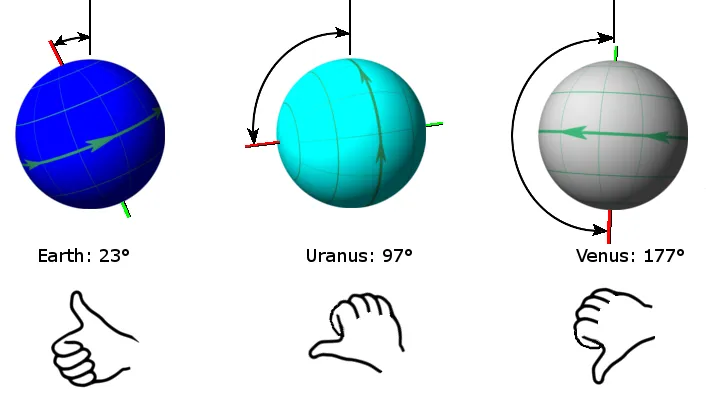
Photo: Tfr000 (talk) 13:49, 2 April 2012 (UTC), CC BY-SA 3.0, via Wikimedia Commons
Imagine living on a planet where a single day lasts longer than an entire year. One side of the world bakes under a relentless sun while the other sits frozen in perpetual darkness. Sounds like science fiction, right? Well, for Venus, that's just Tuesday — or rather, that's just every day. And it turns out, the speed at which a planet rotates might be one of the most underappreciated factors in the entire cosmic recipe for life.
We spend a lot of time talking about the habitable zone — that sweet spot around a star where liquid water can exist on a planet's surface. But astronomers are increasingly realizing that how fast a world spins, which way it tilts, and how stable that spin remains over millions of years are just as critical. Think of rotation as the hidden dial on the universe's life-support system.
Earth Hits the Rotational Sweet Spot
Let's start with home base. Earth completes one full rotation every 24 hours — a rhythm so deeply embedded in our biology that our bodies have literally evolved around it. Our circadian clocks, sleep cycles, and even cellular repair processes are tuned to this roughly day-night cadence.
But the benefits go way beyond biology. Earth's rotation drives the global circulation of both the atmosphere and the oceans. As our planet spins, it deflects moving air and water through something called the Coriolis effect, creating the great weather systems, ocean currents, and wind patterns that redistribute heat across the globe. Without that spin, the tropics would be scorched and the poles would be even more brutally cold than they already are.
Earth's axial tilt — currently about 23.5 degrees — adds another layer of complexity. That tilt is what gives us seasons, and seasons are surprisingly important for life. They drive nutrient cycling, influence animal migration and reproduction, and keep ecosystems dynamic rather than locked into static, unchanging states.
Here's the kicker: Earth's tilt has remained relatively stable over geological time, largely because our unusually large Moon acts as a gravitational stabilizer. Without the Moon gently holding our axis in check, Earth's tilt could swing wildly over millions of years — a chaotic wobble that would wreak havoc on long-term climate stability.
Venus: A Cautionary Tale in Slow Motion
Now swing over to our nearest planetary neighbor, Venus. On paper, Venus sits within a range that might seem vaguely habitable — it's roughly Earth-sized and not dramatically farther from or closer to the Sun than we are. But Venus is a nightmare, and its rotation is a big part of why.
Venus rotates so slowly that its day — the time it takes to complete one full spin — is actually longer than its year. It takes about 243 Earth days to rotate once, but only 225 Earth days to complete an orbit around the Sun. To make things even stranger, it spins backwards compared to most planets.
This sluggish rotation has profound consequences. Without a meaningful day-night cycle driving atmospheric circulation the way Earth's does, Venus developed a runaway greenhouse effect that cranked surface temperatures up to around 900 degrees Fahrenheit — hot enough to melt lead. The slow spin also means Venus generates a much weaker magnetic field, leaving its atmosphere exposed to stripping by the solar wind over billions of years.
Venus is essentially a warning label for what happens when a planet loses the rotational lottery.
Mars: The Wobbling World
Mars presents a different kind of problem. Its rotation rate is actually pretty similar to Earth's — a Martian day is about 24 hours and 37 minutes, which is almost suspiciously familiar. Mars even has a tilt close to Earth's, giving it seasons.
So why isn't Mars teeming with life? Well, rotation is only part of the story, but Mars's rotational history is a mess. Unlike Earth, Mars has no large moon to stabilize its axial tilt. Over millions of years, Mars's tilt has swung dramatically — possibly ranging anywhere from near zero degrees to over 60 degrees. That kind of long-term instability would send its climate through wild swings, cycling between periods of extreme glaciation and dramatically different atmospheric conditions.
Astronomers believe that this axial chaos, combined with Mars's thin atmosphere and lack of a global magnetic field, made it nearly impossible for any complex life to gain a stable foothold — even if simple microbial life may have had a shot early on.
The New Frontier: Exoplanet Spin Rates
Here's where things get really exciting for the future of the search for life beyond our solar system. As telescopes like the James Webb Space Telescope and upcoming missions push deeper into the catalog of known exoplanets, scientists are starting to factor rotation into their habitability assessments in a serious way.
Many of the most promising potentially habitable exoplanets orbit red dwarf stars — smaller, cooler stars that are incredibly common in our galaxy. The problem? Planets in the habitable zones of red dwarfs tend to be tidally locked, meaning one side permanently faces the star and the other is in eternal night. That's basically the extreme version of Venus's slow-spin problem.
Could life survive on a tidally locked world? Maybe. Some models suggest that with the right atmospheric thickness, heat could be transported from the day side to the night side efficiently enough to create survivable conditions. But it would be a wildly different environment from anything we know, and the jury is still very much out.
On the flip side, a planet that spins too fast might also run into trouble — generating extreme atmospheric turbulence and storm systems that make surface conditions brutally harsh.
The Goldilocks Spin
What researchers are piecing together is a kind of rotational Goldilocks zone — not too fast, not too slow, with a stable enough tilt to maintain consistent seasons over geological time. Earth, with its Moon-stabilized axis and 24-hour rhythm, sits comfortably in that zone. It's a combination that looks less like a coincidence and more like an extraordinarily specific set of circumstances.
That doesn't mean Earth is the only possible template for life. The universe is endlessly creative, and biology has a way of finding footholds in the most unexpected places. But when astronomers scan the skies for the next potentially life-bearing world, they're increasingly paying attention to how fast that distant planet is spinning — because in the cosmic casino of habitability, rotation might just be one of the most important chips on the table.
Next time you watch the sun rise or set, take a second to appreciate that 24-hour spin beneath your feet. It's not just keeping your sleep schedule intact. It's part of the reason you exist at all.