One Small Nudge, One Giant Catastrophe: The Hidden Physics Steering Asteroids Toward Earth
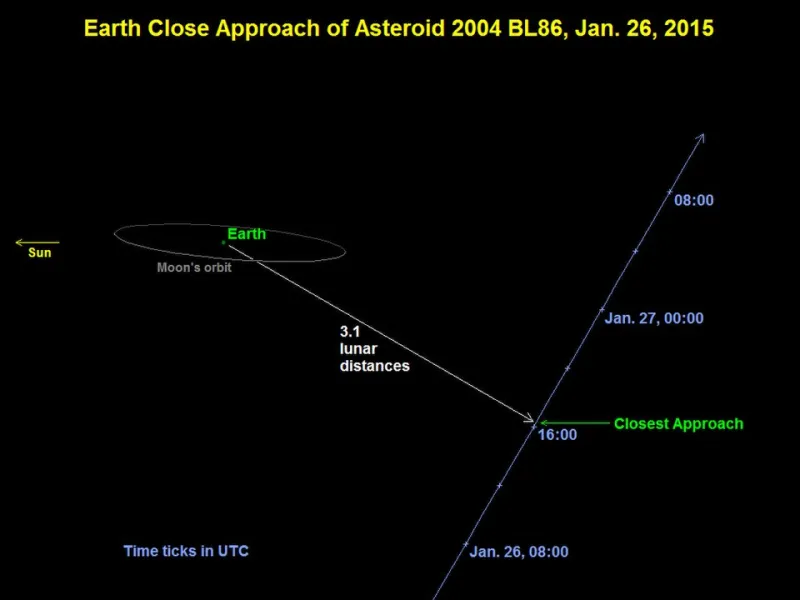
Photo: NASA/JPL-Caltech, Public domain, via Wikimedia Commons
Picture a bowling ball rolling down a lane. Now imagine that lane is millions of miles long, lined with invisible magnets that tweak the ball's path by a fraction of a millimeter every few years. By the time that ball reaches the end of the lane, it might be headed straight for the gutter — or straight for a strike you never saw coming.
That's essentially what's happening with potentially hazardous asteroids right now, all across our solar system. And the scary part? The forces doing the nudging are almost laughably small.
The Gravitational Game of Telephone
Our solar system is not a quiet place. Every planet, moon, and chunk of rock exerts gravitational influence on everything around it. For asteroids cruising through the inner solar system, Jupiter is the biggest bully on the block — its massive gravitational field has been herding space rocks for billions of years. But even smaller players like Mars, Venus, and Earth itself deliver tiny gravitational tugs that, over long timescales, can dramatically reshape an asteroid's orbit.
Scientists call these slow-motion redirections "orbital resonances" and "gravitational perturbations." They sound like dry academic terms, but what they describe is actually a kind of cosmic roulette — a slow spin of the wheel that can gradually nudge an asteroid from a perfectly harmless path into something far more alarming.
Think of it this way: if Jupiter's gravity pulls an asteroid's orbit just slightly inward over the course of a few thousand years, that rock might eventually start crossing Earth's orbital path. Not immediately. Not dramatically. Just... incrementally, the way a car slowly drifts out of its lane on the highway when the driver stops paying attention.
The Yarkovsky Effect: When Sunlight Becomes a Steering Wheel
Gravity isn't the only thing quietly messing with asteroid trajectories. There's another force at work that sounds almost too subtle to matter — and yet planetary scientists have been losing sleep over it for decades.
It's called the Yarkovsky effect, and here's the basic idea: when sunlight hits an asteroid, it warms the surface. As the asteroid rotates, that warm surface eventually faces away from the sun and radiates heat into space. That tiny release of thermal energy acts like an incredibly weak rocket thruster, pushing the asteroid in a direction that depends on which way it's spinning.
On any given day, the force is negligible — roughly equivalent to the weight of a paperclip. But over hundreds of thousands of years? It can shift an asteroid's orbit by thousands of miles. That's enough to move a near-miss into a direct hit, or vice versa.
NASA's OSIRIS-REx mission actually measured the Yarkovsky effect on the asteroid Bennu, one of the most closely watched space rocks in our neighborhood. The data confirmed that Bennu's orbit is shifting by about 284 meters per year because of this sunlight-driven drift. Scientists now factor this into their probability models when calculating whether Bennu could pose a threat later in the century.
Predicting the Unpredictable
Here's where things get genuinely fascinating — and a little humbling. Calculating where an asteroid will be a hundred years from now requires accounting for gravitational tugs from multiple planets, the Yarkovsky effect, potential collisions with other small bodies, and even the subtle pressure of solar wind. Each of these variables carries its own uncertainty, and those uncertainties compound over time like interest on a debt you'd really rather not have.
Modern planetary defense researchers use something called "Monte Carlo simulations" to handle this complexity. Instead of trying to plot a single definitive trajectory, they run thousands of slightly different versions of the same calculation — each one tweaking the input variables just a bit — and see where the asteroid ends up in each scenario. The result is what's called a "probability corridor," a range of possible futures rather than one definitive answer.
For most asteroids, that corridor stays well clear of Earth. But for a handful of rocks — Bennu and Apophis being the most famous examples — the corridor gets uncomfortably narrow at certain points in the future. Apophis, for instance, will pass closer to Earth in 2029 than some of our own satellites orbit. Scientists are confident it won't hit us that time around, but the close pass will alter its orbit in ways that need to be carefully recalculated.
From Watching to Acting
The good news is that humans are no longer just passive spectators in this cosmic game. In September 2022, NASA's DART mission — Double Asteroid Redirection Test — slammed a spacecraft into a small asteroid called Dimorphos and successfully changed its orbital period around its larger companion. It was the first time in history that humanity intentionally and measurably altered the motion of a celestial body.
The implications are enormous. If we can detect a threatening asteroid early enough — decades in advance — even a small nudge could be enough to steer it away from a collision course. The math works out surprisingly well: the farther out you make the correction, the less force you need. A tiny push a hundred years before impact accomplishes what would require an almost impossible amount of energy just a decade out.
This is why early detection matters so much. Programs like NASA's Planetary Defense Coordination Office and the upcoming NEO Surveyor space telescope are designed to find and track near-Earth objects years or even decades before they become a problem. The more lead time scientists have, the more options they have — from a kinetic impactor like DART to more exotic proposals like gravity tractors, which would use a hovering spacecraft's own gravitational pull to slowly drag an asteroid off course.
A Universe That Demands Our Attention
There's something almost philosophical about all of this. The same gravitational forces that built our solar system, that keep Earth in a life-sustaining orbit around the sun, are also the forces that occasionally spin asteroids onto dangerous new paths. It's not malicious. It's not random, exactly. It's just physics, playing out on timescales that dwarf human history.
What makes our moment in time remarkable is that we're the first species — as far as we know — capable of understanding those forces well enough to push back. We can read the spin of an asteroid, calculate the whisper of sunlight pressure against its surface, and project its path forward through centuries of gravitational nudges.
The cosmic roulette wheel is still spinning. But for the first time, we've got a hand on the table.