From Hydrogen to Gold: Inside the Stellar Furnaces That Built the Universe
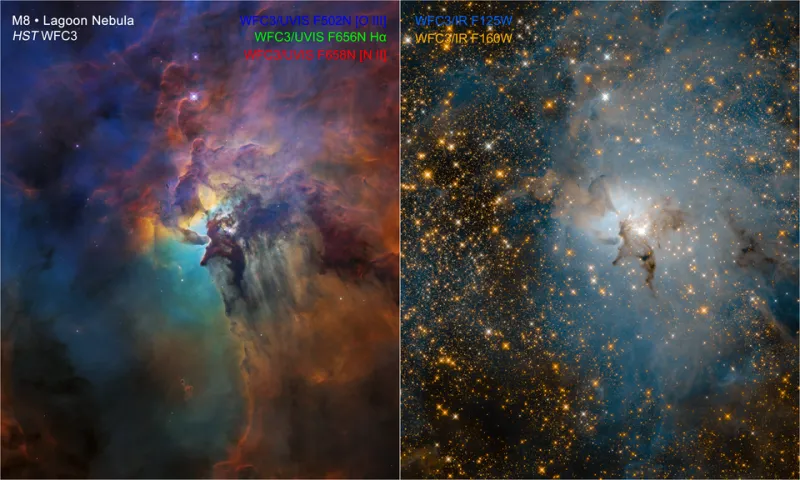
Photo: NASA, ESA, and STScI, Public domain, via Wikimedia Commons
Look down at your hand for a second. The calcium in your bones, the iron zipping through your bloodstream, the oxygen filling your lungs right now — none of it existed when the universe was young. The Big Bang handed the cosmos a pretty limited starter kit: mostly hydrogen, a generous helping of helium, and a tiny sprinkle of lithium. That's it. Everything else had to be made.
So where did it all come from? Stars. Specifically, the nuclear furnaces burning inside them — and the spectacular ways those stars eventually die. This process has a name that sounds almost magical: nucleosynthesis. And once you understand how it works, the night sky will never look quite the same.
The Universe's Starter Dough: Why Hydrogen Isn't Enough
Think of the early universe like a kitchen stocked with only flour and water. You can make something with that, but you're not exactly whipping up a five-course meal. Hydrogen atoms are the simplest things in existence — one proton, one electron, done. Helium adds a couple more pieces to the puzzle. But to build a rocky planet, a living cell, or a gold wedding ring, you need a lot more variety.
That variety comes from a process that requires almost unimaginable heat and pressure: nuclear fusion. When you squeeze atomic nuclei together hard enough, they merge and form heavier elements, releasing enormous amounts of energy in the process. Stars are basically nature's way of creating the conditions for this to happen on a massive, sustained scale.
The catch? Not every star makes the same stuff. A star's mass — how heavy it is when it forms — is essentially its destiny. It determines what elements the star can forge, how long it lives, and what it leaves behind when it's gone.
Small Stars, Simple Recipes
Stars like our Sun sit in the middle of the cosmic weight class. They spend most of their lives fusing hydrogen into helium in their cores — a process that takes billions of years and keeps the star stable and glowing. Eventually, as hydrogen runs low, the core contracts and heats up enough to start fusing helium into carbon and oxygen.
That's a meaningful upgrade from the Big Bang's limited menu, but it's still pretty basic chemistry. When a Sun-like star reaches the end of its life, it puffs up into a red giant, sheds its outer layers in a glowing cloud called a planetary nebula, and leaves behind a dense, cooling ember called a white dwarf. The carbon and oxygen it produced get scattered into space, ready to become part of future planets or living things.
Small stars — the red dwarfs that make up the majority of stars in the Milky Way — are even more conservative. They burn so slowly and steadily that many of them will outlive the current age of the universe several times over. They're not great element factories, but they're extraordinarily patient ones.
When Bigger Stars Get Ambitious
Here's where things get seriously interesting. Stars with much more mass than the Sun — we're talking eight times the Sun's mass or more — live fast and die spectacularly. Their cores reach temperatures so extreme that they don't stop at carbon and oxygen. They keep fusing, building heavier and heavier elements in a series of nested shells, like a cosmic onion.
Carbon fuses into neon and magnesium. Neon into oxygen. Oxygen into silicon and sulfur. Silicon into iron. Each stage burns hotter and faster than the last. What took millions of years in the hydrogen-burning phase might take only days in the silicon-burning phase near the end.
And then the star hits a wall: iron.
Iron is the universe's dead end when it comes to fusion energy. Fusing lighter elements releases energy, which is what keeps a star from collapsing under its own gravity. But fusing iron actually absorbs energy rather than releasing it. The moment an iron core builds up in a massive star, the game is over. The core collapses in a fraction of a second, and the outer layers come crashing inward — then bounce back outward in one of the most violent events in the universe: a supernova.
The Supernova: Where the Really Exotic Stuff Gets Made
A supernova isn't just a dramatic ending — it's also a crucial manufacturing event. The shock wave and flood of neutrons produced during the collapse create conditions that allow elements heavier than iron to form. This is called the r-process (rapid neutron capture), and it's responsible for producing many of the heavy elements on the periodic table: silver, gold, platinum, uranium, and more.
For a long time, scientists weren't entirely sure supernovae alone could account for all the gold and platinum we observe in the universe. Then, in 2017, astronomers detected gravitational waves from a collision between two neutron stars — the ultra-dense remnants left behind after massive stars explode. That event, called a kilonova, produced a staggering amount of heavy elements, including what researchers estimated to be roughly 100 Earth masses worth of gold. It turned out neutron star mergers are probably the universe's premier gold factories.
So the next time someone gives you a gold ring, you can honestly say it was forged in the collision of two dead stars. That's a pretty remarkable origin story.
Silicon, Oxygen, and the Building Blocks of Rocky Worlds
While gold and platinum get a lot of the glamour, some of the most important elements produced by stellar nucleosynthesis are the workhorses: silicon, oxygen, magnesium, and iron. These four elements make up the bulk of Earth's composition. Silicon and oxygen bond together to form silicate minerals — the stuff that makes up most of the rocky crust beneath your feet. Iron sank to Earth's core during the planet's formation, where it still generates the magnetic field that shields us from harmful solar radiation.
Without the silicon churned out by generations of massive stars before our Sun was born, there's no rocky planet. No rocky planet, no solid ground. No solid ground, no us. Every mountain range, every ocean floor, every grain of sand on every beach in America traces its origin back to a star that lived and died billions of years ago.
Every Star Tells a Different Story
What makes nucleosynthesis so fascinating is that it's not a one-size-fits-all process. The universe produces elements through many different pathways — fusion inside living stars, the violence of supernovae, the collision of neutron stars, and even slower processes happening in the outer layers of aging giant stars. Each mechanism leaves behind a different chemical signature, and together they account for the full richness of the periodic table.
Astronomers can actually read these signatures in the light coming from distant stars and galaxies, essentially reconstructing the manufacturing history of different regions of the cosmos. It's like carbon dating, but for the entire universe.
The next time you look up at a clear night sky and spot a bright star, consider what's happening inside it. That light isn't just energy — it's the exhaust of an ongoing construction project, one that's been building the raw materials of planets and life for billions of years. The universe is always cooking. We're just lucky enough to be some of what it made.