Nature's Most Extreme Spinning Objects Are Out There Right Now, Whirling Hundreds of Times a Second
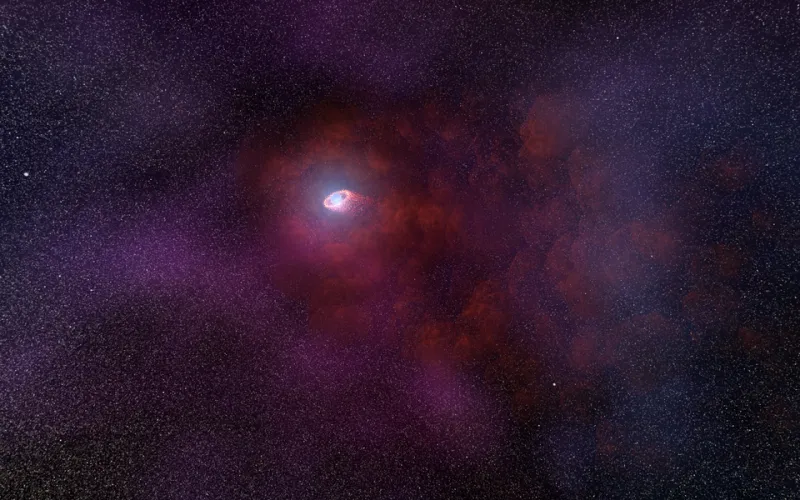
Photo: NASA, ESA, and N. Tr’Ehnl (Pennsylvania State University), Public domain, via Wikimedia Commons
Imagine something about the size of Chicago spinning so fast that its surface is moving at a significant fraction of the speed of light. Now imagine that same object doing this continuously, without slowing down in any meaningful way, for millions of years. That's not science fiction — that's a pulsar, a particular breed of neutron star, and the universe is full of them.
Neutron stars are what's left behind after a massive star — something at least eight times heavier than our Sun — runs out of fuel and collapses in a spectacular supernova explosion. What remains is a ball of matter so compressed that a single teaspoon of it would weigh roughly a billion tons on Earth. But the sheer density isn't even the most jaw-dropping part. It's the spin.
How Does Anything Get That Fast?
To understand why neutron stars rotate so quickly, think about a figure skater pulling their arms in during a spin. As they bring their mass closer to their center, they rotate faster — that's the conservation of angular momentum at work. Now scale that up to a stellar object.
When a massive star collapses, its core goes from being hundreds of thousands of miles wide to just about 12 to 15 miles across in a matter of seconds. Whatever slow rotation the original star had gets dramatically amplified during that implosion. A star that took weeks to complete a single rotation can collapse into a neutron star that spins dozens of times per second almost instantly.
But some neutron stars go even further. A class called millisecond pulsars rotates hundreds of times per second — some clocking in at over 700 rotations per second. The record holder, discovered in 2006 and designated PSR J1748-2446ad, spins at approximately 716 times per second. That means its equator is moving at roughly 24 percent of the speed of light.
Let that sink in for a moment.
What Even Is a Pulsar?
Neutron stars become pulsars when their intense magnetic fields — trillions of times stronger than Earth's — funnel radiation into tight beams that sweep through space like a cosmic lighthouse. If one of those beams happens to point in Earth's direction, we detect a pulse of radio waves (and sometimes X-rays or gamma rays) each time the star completes a rotation.
The first pulsar was discovered in 1967 by astronomer Jocelyn Bell Burnell, who initially nicknamed the signal "LGM-1" — standing for Little Green Men — because the pulses were so regular that they briefly seemed like they could be artificial. They weren't, of course, but the nickname captures just how unnervingly precise these signals are.
That precision is extraordinary. Millisecond pulsars are so stable in their rotation that they rival atomic clocks in accuracy. Astronomers actually use them as tools — networks of pulsars called Pulsar Timing Arrays are being used right now to detect gravitational waves washing through the galaxy, essentially using dead stars as a cosmic detector grid.
The Recycling Story Nobody Talks About
Here's something that doesn't get enough attention: most millisecond pulsars didn't start out spinning that fast. They were spun up over time by a companion star.
In binary star systems, a neutron star can steal gas from its partner. As that material spirals inward and crashes onto the neutron star's surface, it transfers angular momentum — essentially giving the neutron star a long, sustained push. Over millions of years, this process can accelerate a neutron star from a modest few rotations per second all the way up to hundreds. Astronomers call these "recycled pulsars," and they represent one of the stranger recycling programs the universe runs.
The companion star, meanwhile, often ends up as a white dwarf — a smaller stellar remnant that just quietly orbits its now-hyperactive partner. It's a genuinely odd cosmic pairing.
What Happens at the Surface?
The surface of a neutron star is one of the most alien environments imaginable. The crust is thought to be made of a crystalline lattice of atomic nuclei, incredibly rigid and strong. Beneath that, matter transitions into something that doesn't exist anywhere else: a soup of free neutrons packed so tightly that normal atomic structure completely breaks down.
Deep in the core, physicists aren't entirely sure what's happening. Some models suggest that quarks — the particles that make up neutrons and protons — might exist in a free state rather than being bound together. This hypothetical state of matter, called quark-gluon plasma, is something scientists have only briefly recreated in particle accelerators like the Large Hadron Collider. Inside a neutron star, it may exist permanently.
The rapid rotation adds another layer of weirdness. Neutron stars that spin fast enough are theorized to be slightly oblate — squished at the poles and bulging at the equator — but only by a matter of centimeters. The crust is so rigid and the gravity so intense that even tiny structural irregularities can produce detectable effects. When a neutron star's crust cracks — an event called a "starquake" — it can cause a sudden change in rotation rate called a glitch. Astronomers monitoring pulsars have caught these events in real time, giving us rare glimpses into the interior physics of these objects.
Why Any of This Matters
Neutron stars are more than just extreme curiosities. They're laboratories for physics that we genuinely cannot replicate on Earth. The conditions inside them — the pressures, the densities, the magnetic field strengths — push matter into regimes where our standard models start to creak and groan.
Studying how fast a neutron star can spin before it tears itself apart, for instance, gives physicists constraints on what kind of matter exists in its core. If a neutron star can spin at 716 times per second without flying apart, that tells us something about the stiffness of the material inside it. Different theoretical models of neutron star interiors make different predictions, and observations of real pulsars help narrow down which models are correct.
There's also the gravitational wave angle. When two neutron stars spiral toward each other and merge, they produce ripples in spacetime that detectors like LIGO can pick up. The 2017 detection of a neutron star merger — called GW170817 — was one of the most significant astronomical events in recent memory, observed simultaneously in gravitational waves and light across the electromagnetic spectrum. The spinning history of those stars played a role in how the merger unfolded.
The Universe's Most Reliable Clocks
There's something almost poetic about the fact that the violent death of a star can produce something so precise and so steady. Pulsars have been ticking away out there long before humans existed, long before Earth formed, spinning with a regularity that makes our best mechanical timepieces look sloppy by comparison.
We point our radio telescopes at them, catch those rhythmic pulses, and use them to probe the fabric of spacetime itself. In a way, the universe handed us a set of precision instruments built from stellar catastrophe — and we're still figuring out everything they can tell us.
Next time you think about spinning — a basketball on a finger, a top on a table — just remember there are objects out there doing it 700 times a second, and they've been at it for longer than the Earth has existed.