Caught Napping: The Stars That Spin So Slowly Scientists Can't Explain It
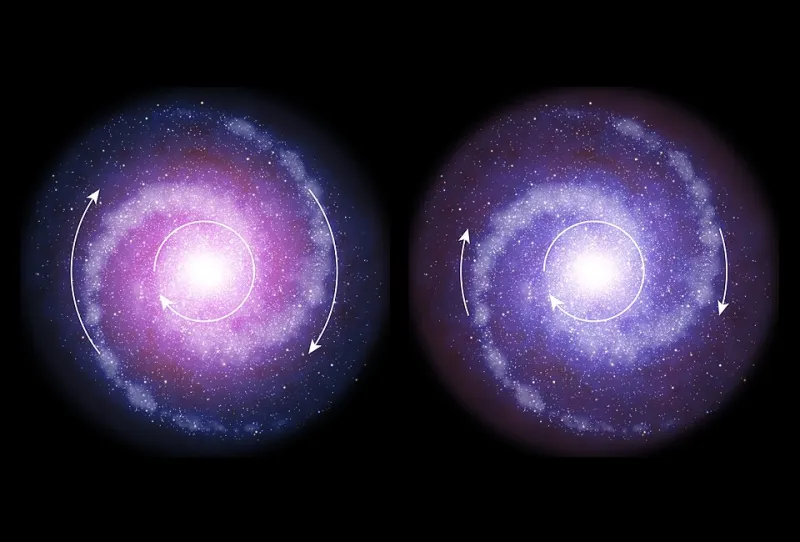
Photo: ESO/L. Calçada, CC BY 4.0, via Wikimedia Commons
When most of us picture a star, we imagine something blazing and dynamic — a roiling ball of plasma doing, well, a lot. And sure, plenty of stars are genuinely hectic. Neutron stars can cram more mass than our Sun into a sphere the size of Manhattan and still spin hundreds of times per second. Pulsars beam radiation across the galaxy like the universe's most dramatic lighthouse. Space, it turns out, loves to spin things fast.
But here's what doesn't get nearly enough airtime: some stars are barely rotating at all.
We're talking about stellar objects so sluggish in their spin that they make Earth's 24-hour rotation look like a NASCAR qualifying lap. And scientists aren't entirely sure why. Unraveling this mystery means digging into stellar evolution, planetary physics, ancient cosmic collisions, and the surprisingly complicated relationship between a star and the space around it.
Spin Is Kind of a Big Deal in Astronomy
A star's rotation rate isn't just a fun fact — it's a window into its entire life story. Stars are born spinning, inheriting angular momentum from the collapsing clouds of gas and dust that formed them. The faster the original cloud was rotating, the faster the newborn star tends to spin. Young stars, especially, can be real speed demons, whipping around in just a few days.
But stars slow down over time. Our own Sun completes one rotation roughly every 25 days at its equator — a pace that would've seemed leisurely to its younger self. Astronomers actually use this relationship between age and spin rate, a concept called gyrochronology, to estimate how old a star is. The older the star, generally speaking, the slower it rotates. Simple enough, right?
Except some stars are rotating far more slowly than their age alone would predict. And that's where things get genuinely interesting.
The Brakes: How Stars Lose Their Spin
So what slows a star down in the first place? The main culprit is something called magnetic braking. Stars like the Sun generate powerful magnetic fields that extend out into space and interact with the charged particles streaming away from the star — what we call the stellar wind. This interaction acts like an invisible hand dragging on the star's rotation, gradually sapping angular momentum over millions and billions of years.
Think of it like a figure skater extending their arms. When a skater pulls their arms in, they spin faster. Extend them out, and they slow down. Magnetic braking is essentially the universe forcing a star to keep its arms stretched wide, bled of rotational energy across cosmic timescales.
But magnetic braking alone doesn't explain all the cases of extreme slow rotation astronomers have catalogued. Some stars have been found spinning so leisurely that additional mechanisms must be at play.
Planets as Spin Thieves
One fascinating — and somewhat underappreciated — factor is the role of planetary companions. When a star hosts planets, particularly large ones orbiting close in, those planets can gravitationally tug on the star's rotation over time through a process called tidal interaction. The same basic physics that's gradually slowing Earth's rotation (thanks to the Moon's gravitational pull) can operate on a much larger scale between stars and their planetary systems.
In some cases, a large planet on a close orbit can act almost like a brake pad, transferring angular momentum away from the star across billions of years. Researchers have found correlations between stars with massive inner planets and unusually low rotation rates — suggesting that having the right kind of planetary neighborhood can genuinely put the brakes on a star's spin.
This connection between planetary systems and stellar rotation is still being actively studied, and it raises a provocative question: could the presence of slow-spinning stars actually be a subtle hint that those systems harbor planets we haven't detected yet?
Collisions, Mergers, and Cosmic Chaos
Stars don't always live solitary lives, and their social histories can leave marks on their spin rates too. In dense stellar environments like globular clusters — ancient, tightly packed collections of hundreds of thousands of stars — stellar encounters and even outright mergers aren't rare. When two stars collide or one star strips material from another, the resulting object can end up with a rotation rate that looks nothing like what standard stellar evolution would predict.
Some of the most puzzling slow rotators are found in exactly these kinds of crowded environments, hinting that their sluggish spins are souvenirs from a violent past. A stellar merger, for instance, might redistribute angular momentum in unexpected ways, leaving behind a star that rotates far more slowly than its mass and age would suggest.
These cosmic collisions are essentially the universe's way of scrambling the record. When astronomers try to read a star's history through its spin, a past merger can make that biography deeply confusing — like a book with half the pages swapped out from a completely different story.
The Strangest Slow Spinners: Magnetars on Pause
Then there are the truly extreme cases. Magnetars — a type of neutron star with staggeringly powerful magnetic fields — are known for their intense activity. But some magnetars have been observed in what astronomers call a low-activity state, during which their rotation has slowed to a relative crawl compared to typical neutron stars. Their enormous magnetic fields, which are actually what makes them so energetically wild in the first place, also bleed away rotational energy at a ferocious rate.
In a strange twist, the very thing that makes magnetars so powerful is also what eventually pumps the brakes on their spin. It's a cosmic irony: the most magnetically intense objects in the universe are also among the most efficient at spinning themselves down.
What Slow Stars Are Telling Us
Pulling back to the bigger picture, the diversity of stellar rotation rates — from neutron stars whirling hundreds of times per second to stars that take months to complete a single rotation — is itself a kind of cosmic data set. Each outlier, each star spinning far too slowly or too quickly for its apparent age and type, is a clue pointing toward some event or process in its past.
For astronomers, slow-spinning stars are especially valuable because they force a closer look at the full menu of forces shaping stellar evolution: magnetic fields, planetary companions, stellar winds, close encounters, and ancient mergers. No single explanation fits every case, which means the universe is using all of these tools simultaneously, in different combinations, across billions of stars.
The science of asteroseismology — studying the internal vibrations of stars, sort of like stellar seismology — is opening new windows into rotation rates that can't be measured directly. By listening to how a star oscillates, researchers can infer how fast its interior is spinning, sometimes revealing that a star's outer layers and inner core are rotating at completely different speeds. That kind of internal differential rotation adds yet another layer of complexity to an already intricate puzzle.
The Cosmic Takeaway
It's tempting to think of the universe as a place that loves speed — and in many ways, it does. But the stars quietly drifting through space at a leisurely spin are just as scientifically rich as their frantically whirling cousins. They carry the fingerprints of planetary systems, ancient collisions, and magnetic histories stretching back billions of years.
So next time you hear about a pulsar spinning at 700 rotations per second, spare a thought for the stars at the other end of the dial — the ones barely moving at all, keeping their secrets locked away in a slow, patient rotation, waiting for astronomers to figure out exactly what happened to them.
Sometimes the most interesting stories are told at the slowest pace.